

Real utility savings from an energy-efficient new home

Kevin Clark
• 12 min read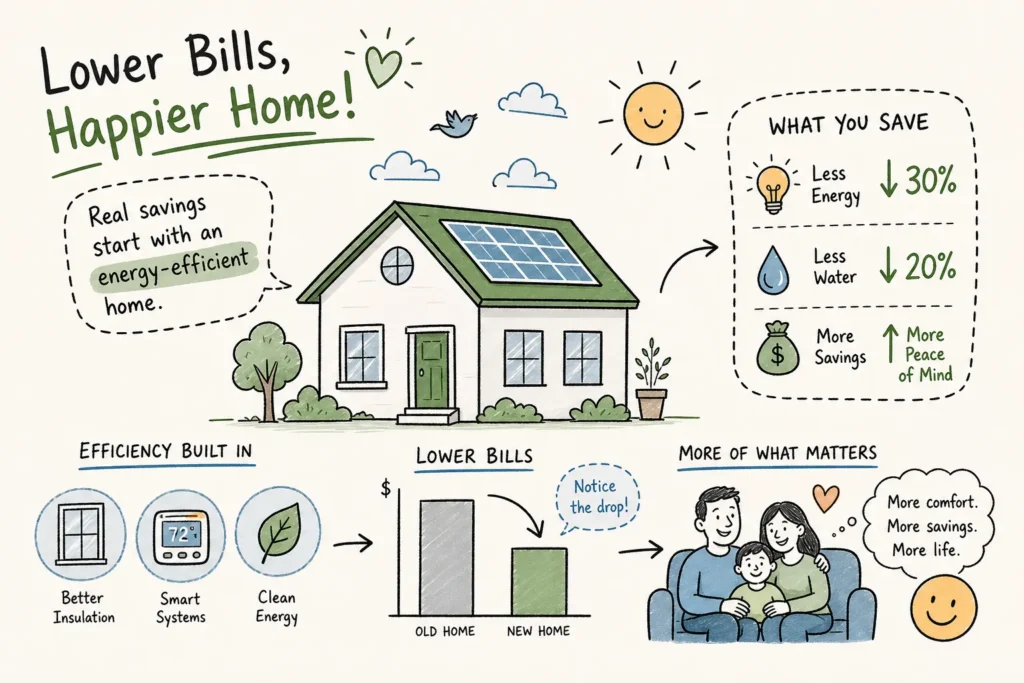
How much can I save on utilities with an energy efficient new home in Greater Cincinnati? It’s the question almost no one asks at the sales center, but it will affect your finances every single month for the next 30 years. Before you close on a new home, most buyers focus on the mortgage payment, the school district, and the square footage. Utility bills in the Cincinnati area average between $4,000 and $4,600 annually for a typical single-family home, and that number climbs with every rate increase your utility company issues. The home you choose today determines whether you’re on the right or wrong side of that math.
An energy-efficient new home isn’t a premium amenity. It’s a financial decision with a measurable annual return. At John Henry Homes, energy efficiency is built into every home across our Greater Cincinnati and Northern Kentucky communities as a standard practice, not a line-item upgrade. That means buyers aren’t negotiating for savings after the fact, they walk in from day one with real money staying in their pocket. This article gives you the actual numbers: what you can realistically save by feature, how payback periods work, and which 2026 incentives are still on the table.
How Much Can I Save on Utilities with an Energy Efficient New Home?
The most cited benchmark for new construction efficiency is ENERGY STAR certification, and the headline number is straightforward: ENERGY STAR certified new homes save roughly 20% on total utility bills compared to standard code-built construction. At Cincinnati’s current utility rates, that translates to $200 to $400 per year in savings for a typical home. That’s not a dramatic figure in isolation, but it’s the floor, not the ceiling, and savings accumulate significantly over time.
One thing worth clarifying: this comparison is against other new construction, not against a drafty 1970s split-level. Code-built homes already outperform older housing stock, so the 20% figure represents real incremental savings above a relatively high baseline. When you factor in individual feature upgrades layered on top of base certification, total annual savings climb well past the average. Over a 30-year mortgage, even a modest $350 in annual savings accumulates to more than $10,500, and that’s before accounting for future rate increases that historically trend upward.
The Upgrades That Drive the Biggest Savings in New Construction
Not every efficiency feature delivers the same return. Three upgrades consistently move the needle more than anything else: HVAC systems, air sealing with insulation, and windows. Understanding which does what helps you ask smarter questions when evaluating a new build.
High-Efficiency HVAC and Heat Pump Systems
Heat pump systems cut heating and cooling costs by 20 to 50% compared to standard HVAC, depending on the climate and the fuel source they replace. Annual savings typically range from $300 to over $800, with colder climates seeing the highest returns. Cincinnati sits in IECC Climate Zone 4A, a mixed-humid classification where both winter heating and summer cooling drive meaningful utility costs. That dual exposure makes a properly sized heat pump one of the best investments in a new build, handling both seasons efficiently from a single system.
In Ohio, upgrading from a standard 14, 15 SEER2 system to a high-efficiency 16, 18 SEER2 heat pump adds roughly $1,500 to $4,000 to construction costs. At $500 to $1,800 in annual savings, that premium pays back in five to twelve years, and the system continues generating savings for the remaining life of the home.
Air Sealing and Insulation: The Unsung Workhorse
According to EPA data, air sealing and insulation reduce heating and cooling costs by roughly 15% on average, with air sealing alone saving approximately $200 per year. In Climate Zone 4A, combined upgrades to air sealing and insulation reduce total annual utility bills by around 12%, translating to $180 to $320 per year depending on home size and utility rates. For a 2,200 square foot home, upgrading attic insulation from R-19 to R-49 alone can save $200 to $400 annually on heating and cooling. See ENERGY STAR’s methodology for sealing and insulating for details on how these savings are estimated.
The more important point is timing. Air sealing and insulation are among the lowest-cost efficiency measures to include during construction and among the most expensive to retrofit after the fact. Getting them right during the build is the decision that pays the longest dividend.
Energy-Efficient Windows
Efficient windows reduce heating and cooling costs by 10 to 25% compared to single-pane or older double-pane units, with annual savings running $100 to $400 depending on climate severity and total window area. In Cincinnati’s Zone 4A climate, low-E coatings work on both sides of the calendar: they block solar heat gain in summer and reduce heat loss in winter, making high-performance windows a reliable contributor to year-round savings rather than a seasonal one.
Smart Thermostats and the Smaller Upgrades That Add Up
The biggest efficiency features get the most attention, but a second tier of upgrades adds meaningful savings on top of the foundational work. Individually, each one looks modest. Together, they add another $200 to $400 or more per year to your total savings.
Smart Thermostat Impact on Heating and Cooling Costs
A smart thermostat saves 8 to 12% on heating and roughly 15% on cooling, adding up to $100 to $200 per year in real-world savings. The deeper value is automation: the system adjusts around your schedule without requiring daily manual input. John Henry Homes includes smart home energy management as part of the standard package across our communities, so buyers capture these savings from move-in day without a separate purchase or installation appointment.
LED Lighting and ENERGY STAR Appliances
LED lighting uses 75 to 90% less energy than incandescent bulbs, saving a typical household $50 to $150 annually. When it comes to appliances, ENERGY STAR-rated models save $20 to $150 per unit per year depending on usage frequency, refrigerators and dishwashers in particular add consistent savings across decades of use. Layered across a full home, these smaller items contribute another $200 to $400 per year on top of the gains from HVAC, insulation, and windows.
How Much Can Cincinnati Homeowners Realistically Expect to Save?
National averages provide a useful baseline, but Cincinnati’s specific climate profile changes the math in your favor. Zone 4A means significant heating demand in winter and real cooling costs in summer, so upgrades that perform on both ends of the temperature spectrum deliver value throughout the year.
Consider a realistic example: a 2,200 square foot home in Liberty Township built with a high-efficiency heat pump, upgraded insulation and air sealing, smart thermostat, and ENERGY STAR appliances. Based on documented regional savings for Climate Zone 4A and the individual feature ranges outlined above, combined annual savings versus a standard code-built home of the same size can reasonably reach $600 to $900 per year. Over ten years, that’s $6,000 to $9,000 back in the homeowner’s pocket, before accounting for the modest rate increases that, according to EIA historical data, have averaged roughly 2 to 3% annually in recent years. Learn more about the benefits of new construction homes in Cincinnati and how those baseline features affect long-term operating costs.
John Henry Homes builds these features into homes across our communities in Greater Cincinnati and Northern Kentucky, giving buyers a concrete starting point when calculating their own long-term savings. The efficiency is already there when you close, not something you negotiate for separately.
Payback Periods and How to Calculate Your ROI
Energy-efficient new construction typically carries a 1 to 8% cost premium over standard code-built homes, depending on which features are included. On a $400,000 home, a 3% premium equals $12,000. At $700 per year in savings, that incremental cost pays back in roughly 17 years, and the home continues saving money for the duration of ownership. Framing it as a 17-year payback undersells it. Framing it as a permanent annual return of $700 on an initial investment of $12,000 is closer to how it actually works over a 30-year mortgage.
Here’s a quick breakdown of payback by feature type:
- Heat pump HVAC: $8,000 to $25,000 incremental cost, $500 to $1,800 per year in savings, payback of 5 to 12 years
- High-performance windows: $8,000 to $30,000 cost, $150 to $800 per year in savings, payback of 10 to 25 years
- Smart thermostat: Minimal cost when included at build, $100 to $200 per year in savings, payback under 2 years
- Air sealing and insulation: Low incremental cost at construction, $180 to $320 per year in savings, among the fastest payback of any upgrade
The consistent theme across all of these: the best time to add them is during construction. Retrofit pricing after move-in is substantially higher, and the disruption to a finished home adds cost and inconvenience that make the math far less favorable.
2026 Incentives Worth Knowing Before You Close
Two important things changed in 2026 that affect the financial picture for buyers of energy-efficient new homes. Understanding both helps you ask the right questions before closing.
The 45L Federal Tax Credit and Its June 30, 2026 Deadline
The 45L federal tax credit gives builders up to $5,000 per home for DOE Zero Energy Ready construction, or $2,500 for ENERGY STAR certified homes. One thing to know before you close: this credit only applies to homes where ownership transfers before July 1, 2026. After that date, the credit disappears under current law. Some builders apply this credit toward pricing incentives or buyer-facing packages, but practices vary, ask your builder directly whether it applies to the home you’re considering and how it’s reflected in the purchase price. For more on federal programs tied to efficient new homes, see the DOE Efficient New Homes incentives and how they interact with builder-side credits.
Utility Programs and State Rebates Still Available in 2026
Federal homeowner tax credits for efficiency upgrades, including the Energy Efficient Home Improvement Credit for insulation, windows, and HVAC, expired December 31, 2025, and are no longer available for 2026 closings. That said, utility-level rebate programs continue in 2026, with some offering $250 to $10,000 or more for certified efficient new builds depending on the provider. Ohio homebuyers should contact their local utility directly (Duke Energy Ohio customers, for example, can check current program availability on Duke’s website) and ask specifically about programs tied to ENERGY STAR or DOE Efficient New Homes certification before closing.
Ohio also has state-level rebate programs funded through the Inflation Reduction Act, including the HOMES and HEAR programs, that were in rollout as of mid-2026. These offer $2,000 to $4,000 or more for qualifying homeowners, with higher amounts available for households under 80% of area median income. Check the Ohio Department of Development’s Home Energy Savings Program for current application availability. For background on federal and programmatic administration tied to ENERGY STAR and HOME-style programs, see this guidance on ENERGY STAR and HOME program administration. A builder with a clear efficiency standard, like John Henry Homes, will have straightforward answers about which certifications apply to each home and which programs you can pursue.
The Savings Are Real, and the Time to Capture Them Is Now
If you’re still asking how much you can save on utilities with an energy efficient new home, the short answer for Cincinnati buyers is: more than most people expect, and consistently across every season. The region’s mixed climate means you’re not paying for features that sit idle half the year. Insulation keeps heating bills down in January. The heat pump handles a humid July without breaking the budget. Low-E windows reduce solar gain in August and heat loss in December.
These features are dramatically cheaper to include during construction than to retrofit later. The insulation is already in the walls, the heat pump is already sized for the system, and the smart thermostat is already wired in. That’s exactly how John Henry Homes approaches every new build across our Greater Cincinnati and Northern Kentucky communities, efficiency built into the structure from day one, not added on as an afterthought. Learn more about our approach to energy efficiency and what it means for your operating costs.
If you’re evaluating a new home and want to understand what utility savings are actually built into a specific floor plan, reach out to our team. We’ll walk you through the efficiency standards included in any home you’re interested in, what certifications apply, and which 2026 incentive programs are worth pursuing before you close.
Turning Leaf: New Homes in Hamilton Township’s Little Miami School District
Josh Blatt
• 14 min read
Is a Smart Home Worth It? What Comes Standard in a New John Henry Home
Josh Blatt
• 7 min read
New Construction Homes in Colerain Township: A Guide to Hunters Ridge
Josh Blatt
• 4 min read
New Homes in Liberty Township: Why Families Choose Caravel and Lakota Schools
Josh Blatt
• 4 min readRelated Articles

Is a Smart Home Worth It? What Comes Standard in a New John Henry Home

What Is the HERS Index? What It Means for Your New Cincinnati Home
Green building practices for new homes that cut bills
Want to know how to buy and sell a home effectively
Get exclusive access to the best homes on the market by signing up today.