

New construction vs. existing home: the buyer’s guide

Kevin Clark
• 11 min read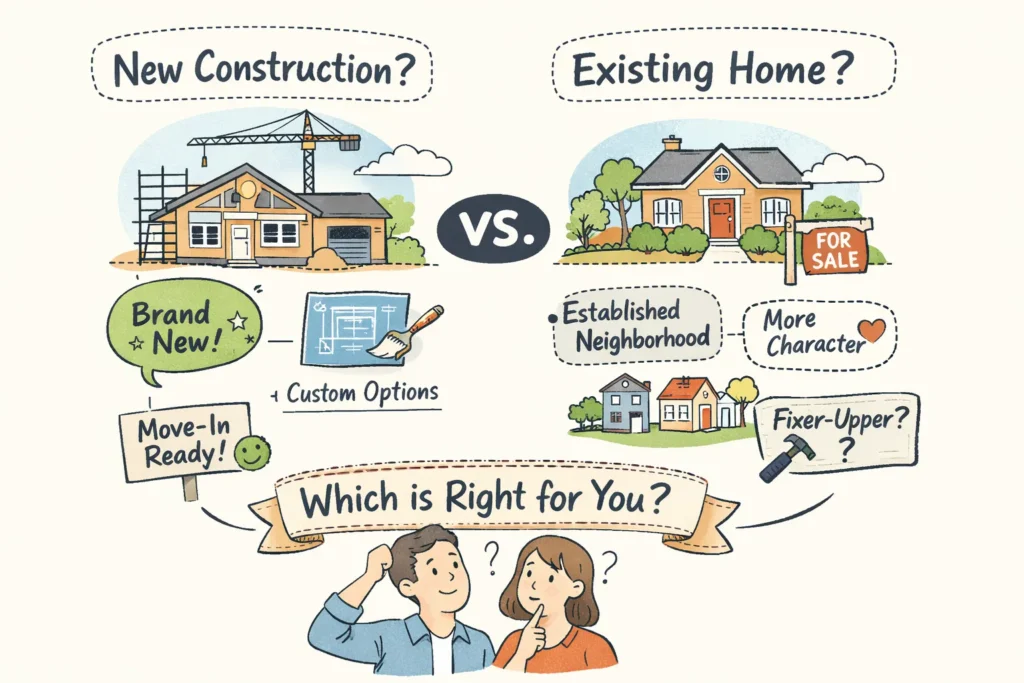
How is buying a new construction home different from buying an existing home? For most buyers, the gut answer involves paying more and waiting longer for a new build, but in 2025, that assumption deserves a closer look. In many markets, the price gap has nearly closed, and the full cost comparison shifts further when you account for what older homes cost after closing. Whether you’re searching in Greater Cincinnati or weighing your options elsewhere, the differences go well beyond the sticker price. This guide walks through six factors that genuinely matter: customization, cost, timelines, inspections, warranties, and financing. Compare them honestly and you’ll be able to choose the path that fits your life right now.
Neither option is automatically better. The right call depends on your timeline, your risk tolerance, and what you value most in a home.
How much design control you actually get
This is where the comparison between a new build and a resale home starts, because design decisions shape everything from daily function to long-term satisfaction. New construction gives buyers a level of personalization that a resale property simply cannot match, but the degree of control varies depending on the build type you choose.
Fully custom builds let you select the floor plan, room sizes, finishes, and features from the ground up. Spec homes, also called quick-delivery homes, are built to a set design but still allow finish selections like flooring, countertops, cabinet hardware, and fixtures. Both options give buyers considerably more influence over the final product than a resale purchase does. If you’re trying to decide which approach fits you best, read this piece on choosing between production and custom builders for a practical comparison of trade-offs.
With an existing home, you’re buying someone else’s design decisions. That can mean outdated layouts, finishes you’ll want to replace immediately, or a kitchen that doesn’t work for how your family actually lives. Renovation costs to undo those choices add up fast, and they’re rarely reflected in the listing price. A kitchen remodel or a flooring replacement across the main level alone can run $20,000 or more before you’ve settled in, and that’s before addressing anything structural.
Quick-delivery new construction sits in a practical middle ground. Buyers get modern finishes, updated floor plans, and integrated features without committing to a multi-month build timeline. For buyers who want the benefits of new construction but can’t wait a year, this option deserves serious consideration.
The real price gap, and what older homes cost after closing
The number most buyers fixate on is the list price. That’s not the full picture, and focusing on it alone leads to decisions people regret.
In Q1 2025, the median new construction home was priced at $416,900 compared to $402,300 for existing homes, a gap of roughly $14,600, or about 3.6% (per U.S. Census Bureau / HUD new residential sales data). On a per-square-foot basis, new homes in several regions came in at a lower rate. By Q4 2025, that gap narrowed further, with new construction coming in approximately $9,600 below the median resale price. Once builder incentives are factored in, the premium for new construction is smaller than most buyers expect going in.
Resale homes carry deferred maintenance risk that doesn’t show up in the purchase price. A roof nearing the end of its life or an HVAC system from the early 2000s can add $15,000 to $30,000 in necessary repairs on their own, and those are often just the visible problems. Sellers are rarely required to fix these issues, and in competitive markets, buyers frequently give up negotiating leverage just to get an offer accepted.
The honest calculation isn’t purchase price versus purchase price. It’s total cost of ownership over your first five years. When you run those numbers, the gap between new construction and resale often shrinks considerably, and in many cases, the new build comes out ahead. For a localized perspective on the real expenses that can arise when building or buying in the Cincinnati area, see our analysis of hidden costs of Cincinnati new home construction.
Move-in timelines: new construction vs. existing home
Timeline is one of the most misunderstood factors in this decision, and getting it wrong has real consequences if you have a hard move-in deadline.
Build type determines your timeline more than anything else. Quick-delivery spec homes can close in 30 to 45 days, which is comparable to a typical resale purchase. Semi-custom builds take 4 to 6 months. Fully custom homes run 10 months to well over a year, depending on complexity, supply chains, and local permitting. If you have a school enrollment deadline, a lease expiration, or a job relocation driving your schedule, your build type choice matters enormously.
Contract to close on a resale home averages 30 to 45 days. Move-in usually happens on closing day, though rent-back arrangements with sellers can push that window by days or weeks. The timeline is more predictable in structure but still depends on seller coordination, which introduces its own variability.
Buyers who assume all new construction requires a long wait are often surprised to learn that quick-delivery homes compete directly with resale on timing. That speed, combined with warranty protections and modern finishes, makes spec homes a stronger option than many buyers initially realize.
Inspections and buyer protections
The inspection process looks very different depending on whether you’re purchasing new construction or a resale property, and understanding that difference protects your investment.
A brand-new home is not automatically defect-free. Builders work under tight schedules, and errors happen. Buyers should request phased inspections at three stages: pre-foundation, pre-drywall, and final walkthrough before closing. Each phase catches a different category of issue, from structural framing errors to problems hidden behind finished walls. An independent inspector adds a layer of accountability that the builder’s own quality process cannot replicate on its own.
Builder warranty vs. seller warranty: what’s actually covered
New construction homes typically come with an industry-standard 1-2-10 warranty structure. The first year covers workmanship and materials. Years one through two cover mechanical systems, HVAC, plumbing, and electrical. The full ten-year period covers major structural defects in load-bearing components like the foundation, framing, beams, and roof systems. For a breakdown of how the common 1-2-10 warranty is structured and what it typically covers, see this explanation of the 1-2-10 warranty.
Resale homes offer no equivalent protection. Some sellers include a one-year home warranty as a negotiating tool, but the coverage scope is generally narrower than a full builder warranty, typically limited to mechanical system failures and often subject to deductibles and exclusions that vary by policy. For a complete side-by-side, it’s worth reviewing what a specific seller warranty covers before assuming it’s comparable.
For existing homes, a single comprehensive inspection covers visible wear, major systems, foundation, and roof. Buyers should include a standard inspection contingency allowing 7 to 10 days post-offer to review findings and negotiate repairs or credits. In competitive markets, some buyers waive this contingency entirely, which is a meaningful financial risk on a home with an unknown maintenance history. Never waive an inspection contingency on an older home without understanding exactly what you’re accepting. For a clear legal perspective on inspection contingencies and how they work in purchase contracts, consult this guide to inspection contingencies.
Financing differences and builder incentives worth understanding
How you finance a new build differs from a resale purchase in ways that directly affect what you pay at the closing table and each month going forward.
Most builders offer incentives tied to using their preferred lender. These typically range from $5,000 to $15,000 in closing cost credits and often include mortgage rate buydowns. A 2-1 buydown reduces your interest rate by two points in year one and one point in year two, lowering your early monthly payments while you get settled. For background on how builder mortgage incentives and rate buydowns work and what homebuyers should watch for, see this overview of builder mortgage incentives.
Not all builder incentives are what they appear, and scrutinizing them carefully pays off. Some builders roll closing costs into the home price while advertising those same costs as “covered.” Others offer design center credits that improve your finishes but don’t reduce your mortgage balance or monthly payment. The right question to ask is whether the incentive reduces your purchase price, your monthly payment, or both. Get competing loan estimates from outside lenders before committing to the builder’s preferred package, even if it means giving up some credits. The structure of closing costs for new construction differs from resale, and understanding that difference is how you avoid leaving money on the table. According to the National Association of Home Builders, a majority of builders were offering some form of financial incentive in 2025 to compete with growing resale inventory in many markets.
Choosing the path that fits your situation
There’s no universal right answer when comparing a new-construction home to an existing one. The right choice depends on your timeline, your budget, your risk tolerance, and what you value most.
New construction fits buyers who want design input, want to avoid near-term repair costs, and value warranty protection and energy efficiency. It also fits buyers who aren’t in a rush or who can use a quick-delivery spec home to meet a tighter timeline. New builds in established communities tend to carry predictable ongoing costs, particularly with energy-efficient construction that reduces utility bills from day one rather than after expensive upgrades.
Resale makes more sense when location is the top priority, since existing homes offer more geographic flexibility and access to established neighborhoods. It’s also the stronger choice when budget constraints favor a lower upfront price in a market where construction costs remain elevated.
At John Henry Homes, buyers have options on both ends of that spectrum. Fully custom builds and quick-delivery homes are available across Greater Cincinnati and Northern Kentucky communities, with pricing starting from the mid-$300Ks. For buyers who want to design from scratch, there’s a path for that. For buyers who need to move within 45 days, quick-delivery homes in communities like Hunters Ridge, Caravel, and Turning Leaf are worth exploring. All John Henry Homes builds include smart home technology, energy-efficient construction, and full builder warranty coverage, features that resale homes don’t come with by default. Learn more about why local home builders in Cincinnati know your dream home better and how working with a local team changes the experience.
How buying a new construction home differs from buying an existing home: making a decision you can stand behind
Across every dimension that affects your daily life and long-term finances, design flexibility, true cost including deferred repairs, timeline, inspections, warranty coverage, and financing structure, the differences between new construction and resale are real and worth understanding before you commit. None of those differences automatically favor one option over the other. What matters is which set of trade-offs lines up with your actual priorities.
Use the framework above to walk through each factor with your real situation in mind. Ask hard questions of your builder, your lender, and your agent before you sign anything. A decision this significant deserves honest answers, not just optimistic estimates. Do your homework upfront, and you’ll choose the right home for the right reasons, and a decision you can stand behind.

Best Cincinnati School Districts for Homebuyers (2025 Guide)
Kevin Clark
• 14 min read
9 Benefits of Buying a Move-In Ready New Construction Home
Kevin Clark
• 11 min read
NterNow home tours: explore any new home on your schedule
Kevin Clark
• 11 min read
Local vs. national homebuilders: what Cincinnati buyers miss
Kevin Clark
• 11 min readRelated Articles

Best Cincinnati School Districts for Homebuyers (2025 Guide)
9 Benefits of Buying a Move-In Ready New Construction Home

NterNow home tours: explore any new home on your schedule
Want to know how to buy and sell a home effectively
Get exclusive access to the best homes on the market by signing up today.