
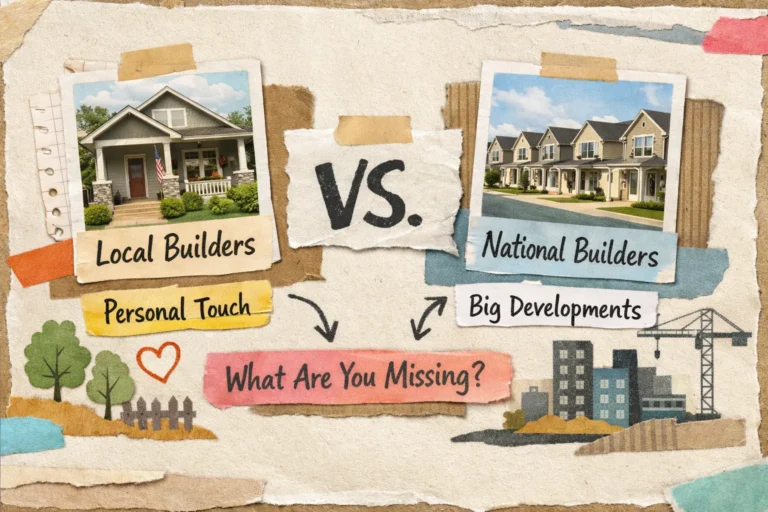

Local vs. national homebuilders: what Cincinnati buyers miss

Kevin Clark
• 11 min read
Picture this: you’re standing in a national builder’s model home in Liberty Township. The quartz countertops are beautiful, the LVP flooring runs perfectly from room to room, and the sales rep is friendly and polished. Everything feels buttoned-up and professional. But somewhere in the back of your mind, a question surfaces: is this really the best way to buy a home in Cincinnati, or is this just the most visible one?
That tension is worth exploring before you sign anything. National builders feel safe because they’re familiar. You’ve seen their billboards on I-75, toured their model homes, and maybe even know someone who bought from one. Mid-sized regional builders operate in a fundamentally different way, and that difference matters more than most buyers realize until they’re already deep in the process. Understanding how a mid-sized builder differs from a national home builder in Cincinnati is one of the more practical things you can do before committing to the largest purchase of your life.
This article isn’t designed to declare a winner. Both builder types serve real needs, and the right choice depends entirely on what you’re after. The five areas where the differences are sharpest: personalization, pricing, communication, local knowledge, and what to ask before you commit.
What these two builder types actually look like
National builders like NVR, Pulte Group, and M/I Homes operate production-style businesses across dozens of metro markets at the same time. Their competitive advantage is volume: standardized floor plans, bulk material purchasing, and streamlined trade contracts let them build efficiently and advertise low entry prices. That model works well for what it’s designed to do.
Mid-sized builders concentrate their work in a specific region, often a single metro area, and build far fewer homes per year. Fewer active communities means deeper investment in each one. Decisions get made locally, not routed through a regional office somewhere in Columbus or Charlotte. Build timelines for semi-custom homes from regional builders typically run 6 to 12 months or longer, reflecting a more hands-on, owner-involved process rather than a slower one. For general industry estimates on home build timelines, see how long it takes to build a home.
The key distinction isn’t quality. A production home built by a national builder can be a perfectly solid home. The distinction is about trade-offs: speed and standardization on one side, flexibility and local investment on the other.
Personalization: how a mid-sized Cincinnati builder differs from national homebuilders
National builders advertise choice, and they do offer it (within carefully managed limits). Selections at a national builder’s design center typically cover countertop packages, flooring colors, cabinet finishes, and fixture styles chosen from a pre-approved inventory. What you generally won’t find is the ability to move a wall, extend the kitchen into what was the dining room, or adjust ceiling heights after you’ve signed. Those structural decisions protect the production schedule, which is a legitimate business reason, but it’s not what every buyer needs.
Mid-sized regional builders treat the floor plan as a starting point rather than a final document. Structural modifications like adding a home office, expanding a primary suite, or adjusting bedroom configurations are part of the design process, not afterthoughts. The finishes and fixture selections also tend to reflect what Cincinnati-area buyers actually want, not a national template built around median preferences across a dozen different markets.
Change orders tell you a lot about a builder’s philosophy. National builders limit structural changes post-contract because every modification risks disrupting a tightly sequenced production schedule. Regional builders build owner involvement into the design phase from the start, which reduces mid-build surprises significantly. Neither builder type can accommodate unlimited changes indefinitely, but the ceiling is much higher when the builder’s business model isn’t built around volume throughput.
What “base price” actually means in Cincinnati
The number in the brochure is not the number you’ll pay. This isn’t unique to Cincinnati, and it isn’t deceptive marketing exactly. It’s a structural feature of how production builders price homes to generate model home traffic. The base price gets you in the door. Lot premiums, structural upgrades, and design center selections get you to the actual cost of the home you want to live in.
Buyers in Cincinnati communities regularly report that mid-range upgrade packages push final costs well above the advertised base price, sometimes by tens of thousands of dollars. Walking into a design center expecting to spend $30,000 in upgrades and leaving having committed to $70,000 is not uncommon. The selections are appealing, the upsells are well-presented, and it all adds up faster than anticipated. Local cost guides also help illustrate how upgrade choices affect final pricing, see how much it costs to build a house in Cincinnati for region-specific context.
Mid-sized builder pricing tends to include more move-in essentials in the base, and transparent, itemized quotes are more common. Buyers can see where each dollar is going before they commit. Quick-delivery and move-in ready options from a boutique home builder like John Henry Homes often carry fixed pricing, which removes the design center guessing game entirely. The base prices from a regional builder can be higher on paper, but the final cost surprise is meaningfully smaller, and that matters for budgeting and your long-term financial picture.
Who actually answers your questions
This is the difference that doesn’t show up in any brochure, but it shapes the entire building experience. National builders operate through layers: an on-site sales rep, a construction manager, a customer care coordinator, and a regional office above all of them. Getting a real answer to a real question often involves multiple handoffs and a waiting period measured in days.
Several national builders active in the Cincinnati area, including names that appear regularly in BBB filings, have accumulated complaints around the same themes: deleted warranty submissions, wrong contact information, unresponsive project managers, and warranty issues that linger for months past when they were reported. Individual people aren’t the problem. The structure is the problem. When you’re a transaction in a high-volume production system, responsiveness scales accordingly.
At a regional builder, the person who can actually say yes to something is usually one phone call away. Project timelines, design questions, and post-sale concerns get addressed by the same team that built the home. That’s not a marketing claim. It’s how a smaller, locally rooted business operates by necessity and by choice.
Construction decisions happen fast, and delayed answers create real delays in framing, selections, and scheduling. A builder’s communication style during the sales process is almost always a preview of how they communicate through construction. At John Henry Homes’ Our Story, buyers work directly with team members who are personally invested in the finished product, which reflects how mid-sized Cincinnati home builders generally operate compared to national production builders.
Local roots versus a national playbook: the mid-sized builder Cincinnati advantage
A national builder brings the same floor plans to Cincinnati that work in Phoenix, Dallas, and Charlotte. They know how to build homes efficiently in many markets. What they often don’t carry is deep knowledge of what makes Greater Cincinnati specifically work: which school districts drive buying decisions, which commuter corridors shape daily life, and which communities will hold value over the long term.
In Greater Cincinnati, school district alignment isn’t a nice-to-have. It directly affects resale value and family decisions. Lakota, Little Miami, and Northwest Local schools are specific, meaningful selling points that a local builder positions communities around deliberately, not incidentally. Commuter corridors like I-75 north, US-42, and US-22 shape lot placement decisions in ways that a builder with nearly two decades of Cincinnati-area experience navigates differently than one chasing land deals wherever the acreage worked nationally.
John Henry Homes has spent nearly two decades building communities that reflect what local families actually want. Caravel in Hamilton Township offers half-acre home sites starting at $659K, positioned around school district access and space for families who need it. Hunters Ridge brings new construction into the mid-$300Ks for buyers entering the market for the first time. Turning Leaf reflects the same purposeful community design philosophy. These aren’t subdivisions placed wherever land was available. For buyer reviews and new-home listings across the Cincinnati area, consult NewHomeSource’s Cincinnati area listings.
How to choose the right builder for your situation
Neither builder type is universally better. If speed and a competitive entry price are your top priorities and you’re flexible on the floor plan and finish selections, a national production builder may serve you well. They’re effective at what they do, and for the right buyer, the trade-offs are worth it.
If you want a floor plan that actually fits your family, direct access to the people managing your build, pricing you can track clearly from deposit to closing, and a builder who understands the Cincinnati market from the inside, a mid-sized regional builder is the stronger fit. Before you sign with anyone, ask these five questions and pay close attention to how each builder answers them:
- Can I meet the person who will manage my build, and how do I reach them directly?
- What is included in the base price, and what triggers an upgrade charge?
- How many structural changes can I make after signing, and by what date?
- Which school district does this community feed into, and how was this community designed around local buyers’ needs?
- What does your post-sale warranty process look like, and who actually handles the repairs?
The answers reveal more than the questions alone. A builder who can answer question one with a name and a direct number is a different experience than one who hands you a customer care portal and a ticket number. A builder who gives you a clear breakdown on question two has already told you something important about how they operate. Ask the same questions of every builder you’re considering, and let the answers do the sorting. You can also browse local builder portfolios on Houzz’s Cincinnati builder directory to compare styles and past work.
The bottom line for Cincinnati buyers
When you’re weighing how a mid-sized builder is different from a national home builder in Cincinnati, the gap is largest in exactly the areas that matter most after you move in. Customization depth, pricing transparency, and communication access all point in the same direction for buyers who want more than a standardized floor plan in a planned subdivision. How well the home fits your life and how clearly you understood what you were paying before closing are questions worth asking now, not after the fact.
The best way to understand the difference is to see it firsthand. John Henry Homes offers self-guided tours through NterNow across multiple Cincinnati and NKY communities, available on your schedule without an appointment. Walk through a home, look at the finishes, and ask the questions above when you connect with the team. Build on your terms, in a community built around where you actually want to live.

9 Benefits of Buying a Move-In Ready New Construction Home
Kevin Clark
• 11 min read
NterNow home tours: explore any new home on your schedule
Kevin Clark
• 11 min read
New construction home tips every first-time buyer needs
Kevin Clark
• 15 min read
10 Home Buying Tips for Move-In Ready Homes
Kevin Clark
• 10 min readRelated Articles
9 Benefits of Buying a Move-In Ready New Construction Home

NterNow home tours: explore any new home on your schedule

New construction home tips every first-time buyer needs
Want to know how to buy and sell a home effectively
Get exclusive access to the best homes on the market by signing up today.